
- How many stages does lipoedema have? Usually three. The classification into stages 1, 2 and 3 only describes the visual and structural state of the fatty tissue.
- Does the lipoedema stage say anything about the symptoms? No. Even a supposedly low stage can be accompanied by considerable discomfort.
- How do the three stages differ? The visual changes become increasingly clear: in stage 1 the skin is still smooth, in stage 2 uneven and wavy, in stage 3 large-nodular with overhanging fat flaps.
- Do lipoedema types describe the same thing as lipoedema stages? No. The stage describes the condition of the tissue, while the four types are based on which regions of the body are affected.
- What does the stage mean for treatment? Since the symptoms are independent of the stage, liposuction can be the therapy of choice even in an early stage.
Lipoedema is a chronic condition that affects women almost exclusively. In this fat distribution disorder, there is a symmetrical and painful increase in subcutaneous fatty tissue, especially on the legs, but also on the hips, buttocks or arms. Lipoedema at a glance
What do the lipoedema stages tell us – and what do they not?
The lipoedema stages serve purely to describe the fat distribution disorder. They do not provide any information about how severe the pain is. This applies in both directions: a supposedly low stage can be accompanied by considerable discomfort, while a higher stage can be associated with less pain.
Due to these varying severities of lipoedema symptoms, medical associations refrain from using the lipoedema stages as an indication for surgery.
The 3 stages of lipedema at a glance
For the sake of completeness, you will find here the stage classification as it was used in the past and is still partly used by health insurance companies today.
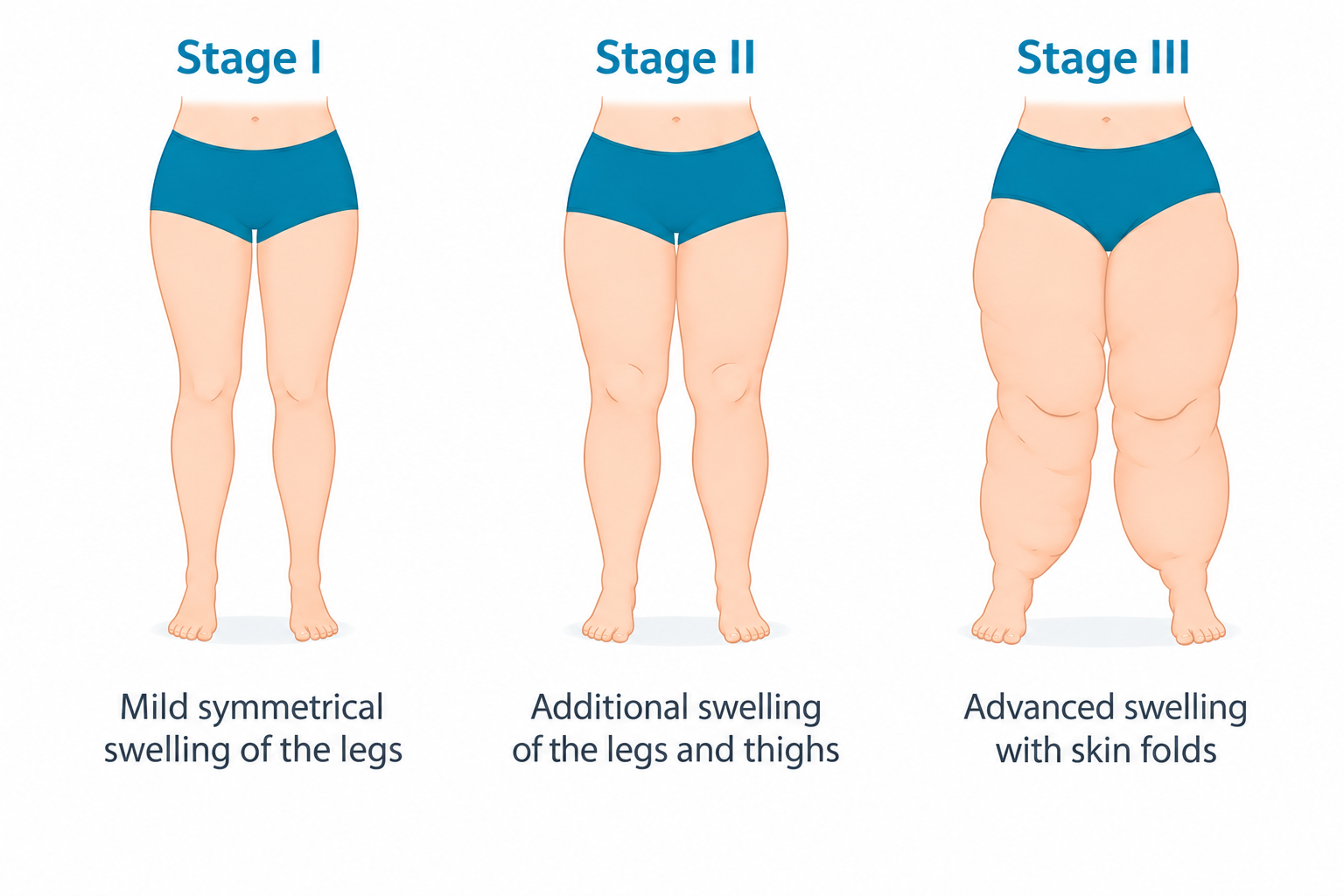
| Stage 1 | Stage 2 | Stage 3 | |
|---|---|---|---|
| Skin surface | still smooth | increasingly uneven, wavy | large-nodular, large overhanging fat flaps |
| Subcutaneous fatty tissue | already thickened | nodular structures palpable | tough and hard |
| Circumference and proportions | fat deposits on legs or arms | legs significantly thickened | increase in circumference very pronounced |
| Symptoms | often already painful, pressure-sensitive fat deposits | pain, feeling of tension and heaviness, oedema possible | further increasing pain and restricted mobility |
Lipedema stage 1
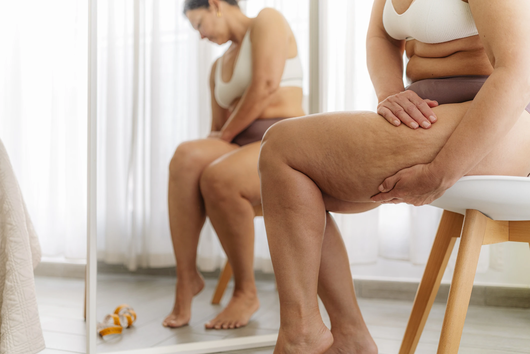
In the initial stage, the skin is still smooth, but the subcutaneous fatty tissue is already thickened. You may already feel painful, pressure-sensitive fat deposits on your legs or arms. This early stage is often confused with obesity. This makes a timely diagnosis all the more important so that you can start conservative therapy early.
Lipedema stage 2
The second stage is characterized by an increasingly uneven, wavy skin surface. Nodular structures in the subcutaneous fatty tissue are now palpable. The legs are significantly thickened and are in disharmony with the slender upper body. The pressure on the lymph vessels increases, which can lead to feelings of tension, heaviness and oedema.
Lipedema stage 3
In the advanced third stage, the tissue feels tough and hard. The skin surface is large-nodular, and large, overhanging fat flaps, known as “dewlaps”, form. The increase in circumference on the arms and legs is very pronounced. Pain and restricted mobility continue to increase and put a strain on the joints and spine.
Would you like to clarify whether your symptoms could be lipoedema? Our experts will be happy to advise you in a personal consultation.
Lipoedema stage and lipoedema type: What is the difference?
In addition to the classification into stages, the fat distribution disorder can also be divided into four types, which are based on the affected body region. Knowing the type helps in choosing the right treatment:
- Type 1: The subcutaneous fat accumulates mainly around the buttocks and hips. The result is what is known as “saddlebags.”
- Type 2: The lipoedema has spread to the knees, with increased fat formation on the inside of the knees.
- Type 3: The disease extends from the hips to the ankles. The feet are not affected.
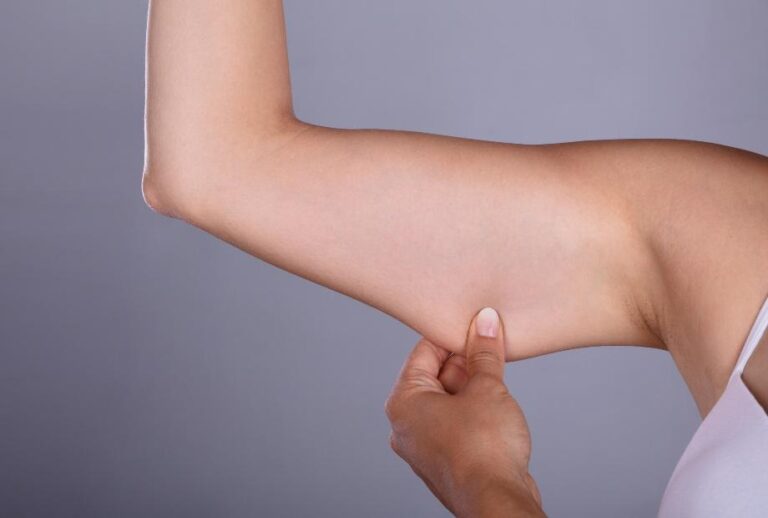
- Type 4: The lipoedema now also affects the arms. Wrists and hands remain unaffected.
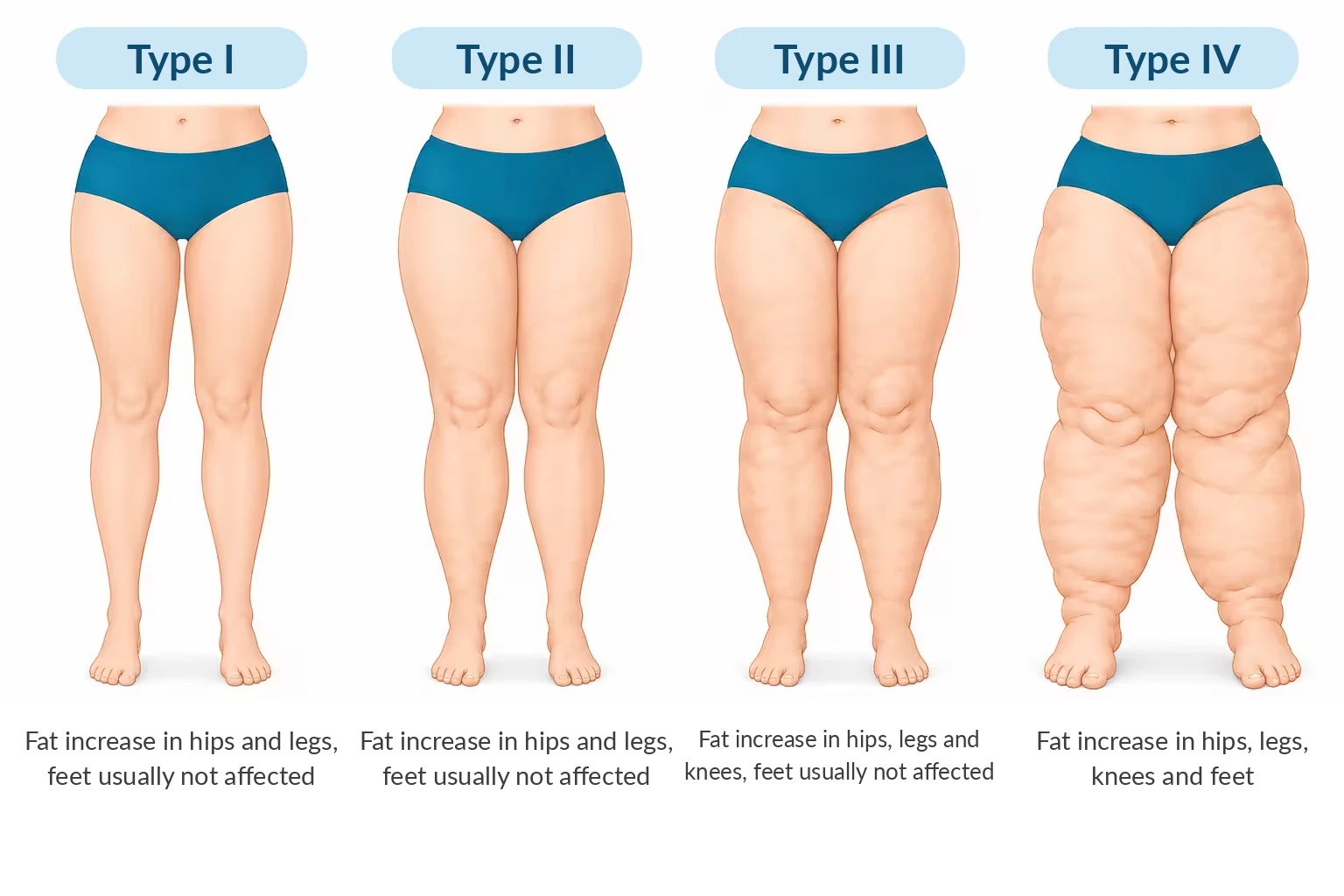
The four types describe the affected body regions, not four degrees of severity. Type IV additionally affects the arms. The representation is therefore not to be understood as a progressive stage classification.
Can an early stage be diagnosed?
Patients who still show few external changes are often not taken seriously. A lipoedema diagnosis therefore requires a trained eye, a targeted medical history and examination by experienced specialists.
Only an early and correct diagnosis ensures that you receive the optimal treatment for your situation.
Our self-test gives you an initial indication of whether you might have lipoedema. However, it is not a substitute for a professional medical diagnosis.
Does the lipoedema stage influence the treatment?
The symptoms of lipoedema are independent of the stages. Medical associations explicitly advise against making a surgical indication based solely on the stage. Therefore, liposuction can be the therapy of choice from stage 1 onwards in order to slow down progression and alleviate symptoms.
In the advanced stages 2 and 3, surgical treatment is often the only way to reduce the massive fat deposits, reduce pain and significantly improve quality of life.
Diagnosis and treatment of lipedema stages at LipoClinic Dr. Heck
As a pioneer in the surgical treatment of lipoedema, LipoClinic Dr. Heck is a world leader with over 2,500 successful operations annually. Our specialized team ensures safe and long-term effective treatment with clinically proven and scientifically documented surgical standards.
In a personal consultation, we will inform you in detail about the possibilities of liposuction and create an individual treatment plan for you.
Would you like to learn more about our holistic approach or exchange ideas with other affected people at one of the LipoTalks?
FAQ – frequently asked questions about the lipoedema stages
No, the course of the disease is individual. Some sufferers remain in an early stage for a long time, while in others the disease progresses more quickly. Factors such as hormonal changes or a lack of treatment can influence the course.
Patients usually find it difficult to categorize themselves, as the stages are often not visually clear. Only an experienced doctor can correctly assess tissue structure, skin changes and symptoms. A professional diagnosis is therefore necessary.
The staging generally applies to both body regions. However, lipoedema on the arms is usually less pronounced or appears later. A precise medical examination helps to determine the individual severity.
No. Medical associations refrain from making a surgical indication based on the lipoedema stages. Rather, the individual symptoms count, i.e. pain, restricted mobility and quality of life.

Dr. Thomas Witte is Medical Director of LipoClinic Dr. Heck and a specialist in plastic and aesthetic surgery. With decades of surgical experience and a deep understanding of the individual needs of lipoedema patients, he is one of the leading experts in this field. His focus is on holistic, safe and empathetic care – always with the aim of restoring quality of life.
- Funke, S., Kuhlmann, C., Taha, S. et al. (2023): In search of evidence: A systematic review of the pathology of lipoedema