- What is lipohypertrophy? An increase in subcutaneous fat tissue that occurs either as symmetrical fat distribution on the limbs or as local thickening at frequent insulin injection sites.
- What distinguishes it from lipoedema? Pain. Lipohypertrophy is painless, without oedema and without increased bruising. In lipoedema, pressure and touch pain are the key symptom.
- Is it a disease? No. The S2k guideline lists the painless form as a predisposition without disease value, and not as a subject of the guideline.
- Can it develop into lipoedema? It is possible, especially with hormonal changes or weight gain. However, it is not inevitable.
- What helps? There is no medication that dissolves lipohypertrophy. The focus is on exercise, nutrition and—if you are on insulin therapy—consistently rotating injection sites.
- Will health insurance cover it? Usually not, because there is no medical necessity.
What is lipohypertrophy?
Lipohypertrophy is an increase in subcutaneous fat tissue that occurs either as symmetrical fat distribution on the limbs—especially in women—or as local thickening at frequent insulin injection sites.
The term therefore describes two quite different things that share the same name in medicine. What they have in common is an increase in fatty tissue without inflammation or fluid retention behind it.
For women dealing with lipoedema, the first form is particularly relevant.
Two main forms of lipohypertrophy
Limb lipohypertrophy
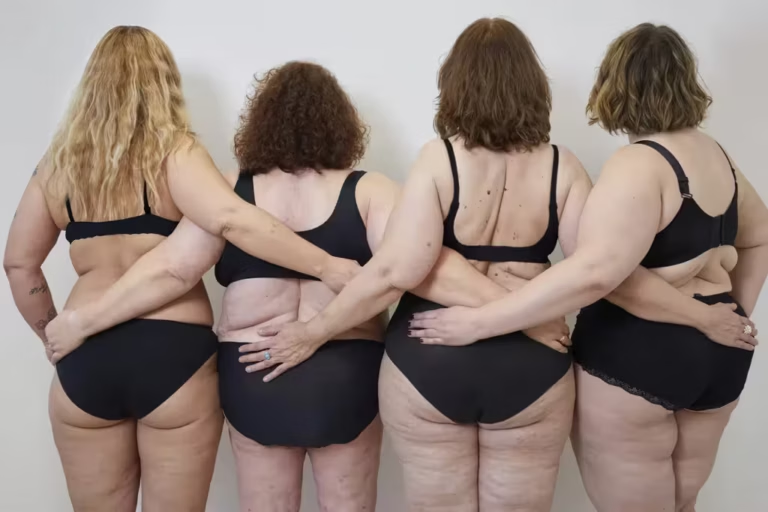
Here, fatty tissue increases symmetrically on the legs, hips, buttocks or arms, while the upper body remains slimmer. Hands and feet are not affected.
Medically, this form is considered a predisposition or normal variant and typically causes no pain. In some cases, hormonal changes or weight gain can lead to lipoedema developing from it.
Insulin-related lipohypertrophy
In people with diabetes, soft or nodular thickenings under the skin can develop in areas where insulin is injected repeatedly. This is independent of the fat distribution disorder on the limbs.
The issue is not cosmetic: in these areas, insulin absorption may be impaired, leading to fluctuating blood sugar levels. Those affected should rotate injection sites consistently, never reuse needles, and temporarily avoid altered areas. Please discuss this with your diabetes clinic/practice.
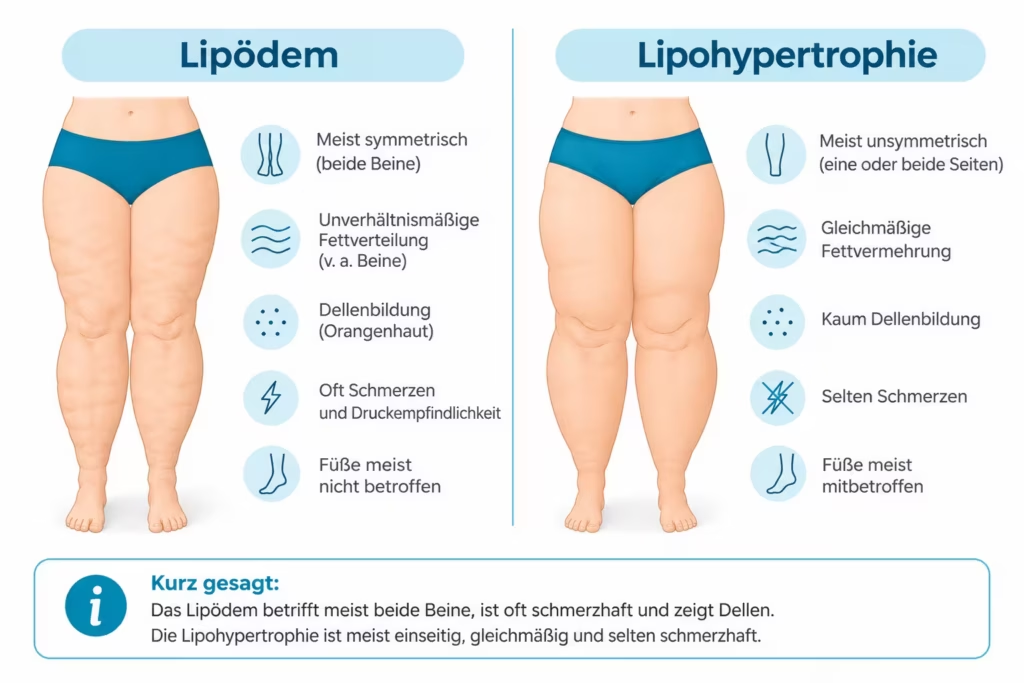
Lipohypertrophy or lipoedema? Pain is the deciding factor
Both terms describe disproportionate fat distribution, which is why they are often confused. However, the S2k lipoedema guideline from January 2024 draws a clear line: lipoedema is always painful. A non-painful, disproportionate and symmetrical fat distribution disorder is referred to as lipohypertrophy and is not covered by this guideline.
| Feature | Lipohypertrophy | Lipoedema |
|---|---|---|
| Pain | absent | key symptom; pressure and touch pain |
| Oedema | no fluid retention | tendency to swelling possible |
| Bruising | no increased tendency | common, often without a trigger |
| Tissue | usually soft and even | nodular, tender to pressure |
| Classification | predisposition without disease value | chronic disease |
| Treatment | exercise, nutrition, prevention | compression, lymphatic drainage, liposuction |
| Cost coverage | usually none | possible under certain conditions |
No. According to the current guideline, this term is not correct. A painless fat distribution disorder should not be diagnosed as lipoedema—not even as a precursor in the sense of its own stage. And: lipohypertrophy is not automatically early lipoedema. You can read more about classification under lipoedema stages.
Can lipohypertrophy develop into lipoedema?
It is possible. The guideline describes lipohypertrophy as a potential precursor: it may remain unchanged for years or develop into lipoedema, particularly with hormonal changes such as puberty, pregnancy or menopause, as well as with significant weight gain.
However, this course is not inevitable. Many women have a stronger leg contour throughout their lives without ever developing pain.
What you should watch for: If pressure or touch pain develops, the skin becomes more sensitive, or bruises appear without a trigger, you should have this assessed by a specialist. In that case, a predisposition may have become a condition requiring treatment.
How is lipohypertrophy diagnosed?
Classification is clinical—through a consultation and physical examination. Key points are:
- Pain history: Is there pressure or touch pain? This is the most important question.
- Palpation findings: Is the tissue soft and even, or nodular and sensitive?
- Distribution pattern: Are the hands and feet spared?
- Differential diagnosis: Is it instead lymphoedema or obesity?
An important note from the current guideline: BMI alone should no longer be used for differentiation. Instead, the waist-to-height ratio and the lipohypertrophy quotient according to Herpertz are recommended.
You can read which specialties may be suitable for assessment under lipoedema: which doctor.
Are you unsure whether you have pain or not? Our self-test can help you classify your symptoms.
What to do if you have lipohypertrophy?
First, the most important point: There is no approved medication—neither tablets nor injections—that specifically dissolves lipohypertrophy. What does help:
- Regular exercise, especially joint-friendly activities in water, supports circulation and lymph flow.
- A balanced diet and stable body weight to avoid further increase.
- Skin care and monitoring to notice changes early.
- Compression only if it subjectively helps you. If you have no symptoms, there is no medical necessity.
- If you are on insulin therapy: rotate injection sites systematically and use needles only once.
Diet and exercise can only influence lipohypertrophy to a limited extent, because the fat distribution is genetic. This can be frustrating, but it does not indicate a disease.
Lipohypertrophy and health insurance: what applies?
Because, by current definition, lipohypertrophy has no disease value, there is usually no medical necessity for treatment. This means:
- In this case, liposuction is considered a cosmetic procedure and is not covered by statutory health insurance.
- Compression garments and lymphatic drainage are also usually not prescribed if there are no symptoms.
- This changes once lipoedema is diagnosed. You can read which requirements then apply under lipoedema and health insurance.
If you would like to change the fat distribution for aesthetic reasons, this is possible as a self-pay service. At our clinic, this is provided via Belaris Clinic, our subsidiary for aesthetic surgery.
Lipohypertrophy without symptoms is no cause for concern and does not require treatment. The key is to remain attentive: if pain develops, the medical assessment changes fundamentally.
Gain clarity about your symptoms
Distinguishing between lipohypertrophy and lipoedema may sound like splitting hairs, but it has significant consequences: it determines treatment, aids and cost coverage. And it determines whether your symptoms are recognised as a medical condition.
At LipoClinic Dr. Heck, we take the time for this assessment. Our team will examine you thoroughly and tell you honestly what we see—even if the result is: this is not lipoedema.
FAQ – frequently asked questions about lipohypertrophy
The key difference is pain. Lipohypertrophy is painless, without fluid retention and without an increased tendency to bruise. In lipoedema, pressure and touch pain are the key symptom. The 2024 S2k guideline explicitly defines lipoedema as always painful.
If you have no symptoms, prevention is the priority: regular exercise, a balanced diet, stable body weight and attentive monitoring. Medical treatment is not necessary. In insulin-related lipohypertrophy, consistently rotating injection sites is crucial.
Yes—if treatment is needed at all. Since it has no disease value, exercise, diet and weight stability are usually sufficient. However, this will not fully reverse the fat distribution, because it is genetic.
It cannot be completely eliminated through diet and exercise, because the fat distribution is predisposed. Liposuction can change the contour, but if you have no symptoms it is considered a cosmetic procedure and is a self-pay service. There is no medication that dissolves lipohypertrophy.
Usually not. Because it is not a medical disease, there is no medical necessity. This applies to liposuction as well as compression garments and lymphatic drainage. Once lipoedema is diagnosed, the assessment changes.
No. According to the current guideline, this term is not correct. A painless fat distribution disorder should not be diagnosed as lipoedema. Lipohypertrophy can be a precursor, but it is not automatically early lipoedema.
With repeated insulin injections in the same area, soft or nodular thickenings can form under the skin. Insulin absorption is often impaired there, leading to fluctuating blood sugar levels. Important measures are systematic rotation of injection sites, single use of needles, and temporarily avoiding altered areas.

- Faerber, G. et al. (2024): S2k Guideline on Lipoedema, JDDG – Journal of the German Dermatological Society
- AWMF: S2k Guidelines of the German Society of Phlebology and Lymphology